

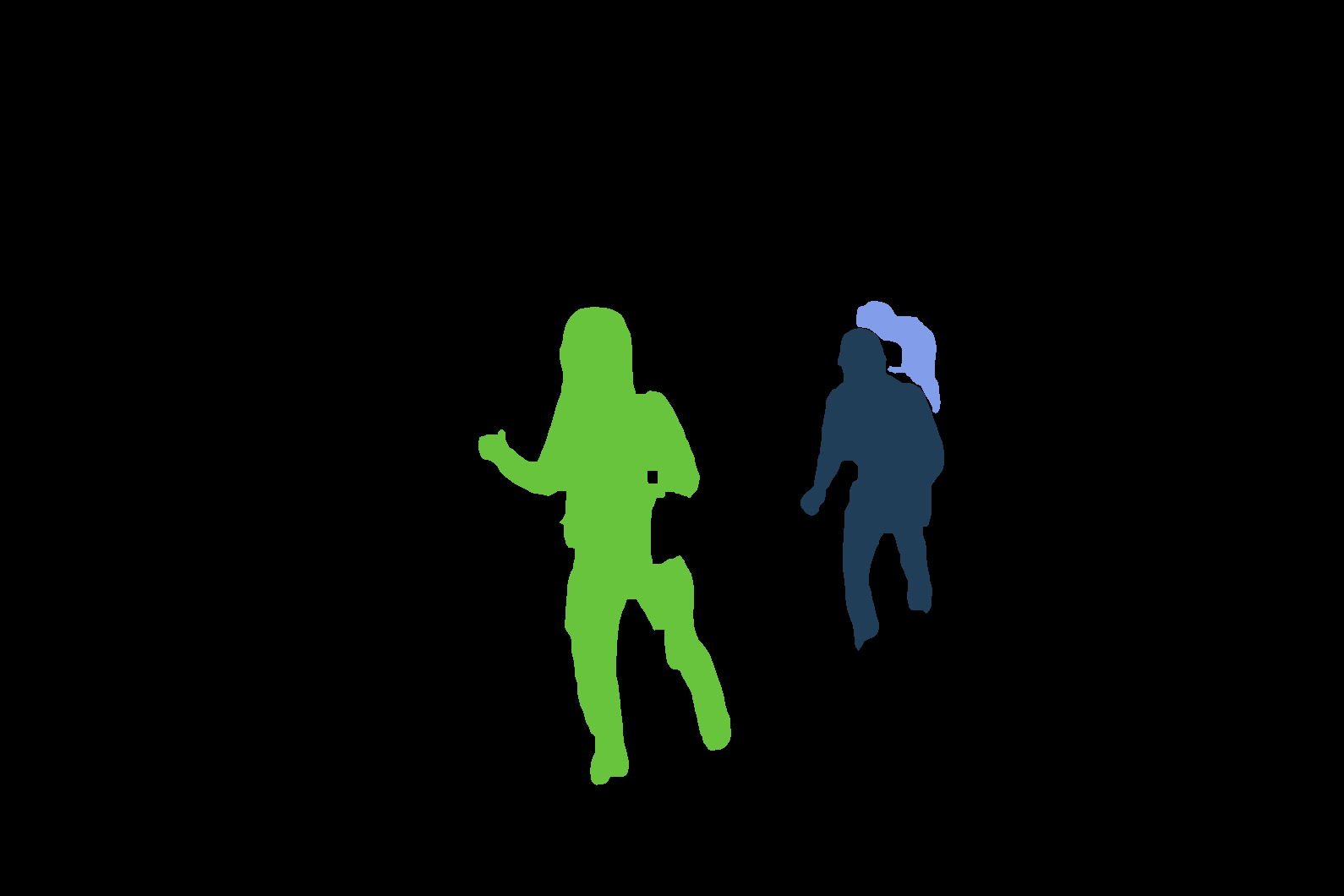
Human instance segmentation identifies different human objects in an image and describes each object with a pixel-level mask.
Introduction
Human instance segmentation uses detection and segmentation technologies to identify different human objects in an image and accurately outline each object with a pixel-level mask.
You can use the Image erase completion API operation to perform AI-powered human removal. To remove one or more people, select their complete mask area.
Scenarios
- Portrait matting: Human segmentation separates the main human subject from the background. This lets you blur the background to create a large-aperture, shallow depth of field effect, which makes the human subject stand out.
- ID photo creation: You can upload or take a casual photo of multiple people. The model precisely segments each person. Combined with the erasing and inpainting capabilities, you can create an ID photo of a single person.
- Marketing advertisement creation: You can segment product images or people from specific scenarios to separate unwanted foreground or background elements from the original image.
Features and benefits
- Adaptability to complex backgrounds: The model can accurately segment a person from a complex background.
- Enterprise-level platform service: The service provides stable responses during periods of high concurrency and heavy traffic. It offers a simple inference API operation that you can call directly.
Getting started
Image input limits:
- Image resolution: The image height and width must be between 512 and 4,096 pixels.
- Image format: JPEG, PNG, JPG, BMP, or WEBP.
- Image size: No more than 10 MB.
- The URL cannot contain Chinese characters.
Input image | Output 1: Pixel-level mask image | Output 2: Visualization image |
|
|
|


{WorkspaceId} with your actual workspace ID.
- curl
1. Create a human instance segmentation taskThe API returns a task ID. You can use this ID to query the image generation result.2. Query the result based on the task ID