

Model Studio APIs limit request volume, token usage, and growth rate. Apply these strategies to maximize throughput and maintain availability.
- Platform configuration solutions (minimal code changes): Server-side queuing, PTU, and Batch API.
- Client-side traffic control strategies (client code changes): Four strategies with increasing engineering complexity, from basic retry to adaptive congestion control.
- Architectural fallback solutions (system architecture changes): Model fallback and peak-load shifting using message queues (MQ).
429 error now, go to Error diagnosis and strategy recommendations to identify the cause. For traffic burst errors, try server-side queuing first — it only requires one request header.
Platform rate limiting mechanism
The platform rate-limits each model independently at the root account level. After triggering, the service typically resumes within one minute. For rate limiting conditions and current usage per model, see Rate limiting and Model monitoring. Three types of rate limiting rules apply:
- Minute-level quota limits (RPM / TPM): The maximum number of requests per minute (RPM) and the maximum token usage per minute (TPM).
- Instantaneous frequency limits (RPS / TPS): Maximum requests per second (RPS) and maximum token usage per second (TPS). Dense API calls or token consumption within a single second can trigger rate limiting.
- Growth rate limits (Traffic Burst): A sudden surge in request volume or token usage triggers rate limiting. The threshold adjusts dynamically. Ramp up requests gradually to avoid triggering this limit.
Error diagnosis and strategy recommendations
The same error code can be triggered by different rate limiting dimensions. High concurrency can also saturate the server, causing timeouts. The adaptive congestion control strategy can help mitigate this.
Error code (DashScope / OpenAI) | Triggering dimension | Feature diagnosis | Recommended strategy |
|---|---|---|---|
Throttling.RateQuota / limit_requests | Request rate exceeded | Intermittent errors. Success rate decreases over time. | Token bucket: Control the request quota per unit of time. |
Request rate exceeded | Concentrated errors at startup or during concurrency spikes. | Concurrency semaphore or smoothing rate limiter: Increase the interval between requests. | |
Throttling.AllocationQuota / insufficient_quota | Token usage exceeded | Intermittent errors when processing long texts. | Dual token bucket: Limit both RPM and TPM quotas simultaneously. |
Token usage exceeded | Instantaneous token consumption is too high during concurrent processing of long texts. | ||
Throttling.BurstRate / limit_burst_rate | Traffic growth rate exceeded | Sudden large volume of requests after startup or recovery from an idle state. | We recommend trying server-side queuing first. Alternatively, use a token bucket with a low initial value, such as |
Platform configuration solutions
These solutions rely on platform capabilities and require minimal or no client-side code changes.
Server-side queuing (recommended)
For traffic burst rate limiting, Model Studio accepts a maximum wait time in the request header. The server queues and retries the request within that time until it starts processing or the queue times out. This significantly improves success rates during traffic bursts compared to an immediate 429 response.
X-DashScope-Wait-Timeout field to the request header:
Header field | Example | Description |
|---|---|---|
X-DashScope-Wait-Timeout | 30 | The maximum queuing wait time for burst requests, in seconds.
|
- Non-streaming requests (stream: false): Timeout = original base timeout + Wait-Timeout value.
- Streaming requests (stream: true): Timeout > Wait-Timeout value. Streaming requests start timing after the first chunk, so the initial response timeout just needs to exceed the queuing time.
Code example
Code example
Provisioned throughput unit (PTU)
The PTU service provides dedicated, reserved computing power. It avoids contention in the public resource pool and is the preferred solution for real-time, high-throughput requirements.
Use PTU when your business has deterministic throughput requirements (such as SLA commitments) or when you want stable, high throughput without client-side traffic control.
PTUs are reserved resources billed continuously, even when not fully utilized. Evaluate required specifications based on actual peak load to avoid waste.
Asynchronous batch processing (Batch API)
For tasks without strict real-time requirements (data cleaning, batch analytics), use the Batch API to submit them for batch processing. Tasks run during off-peak hours, return results asynchronously, and are not subject to online rate limits.
Suitable for offline tasks that tolerate hours-to-days return time: data annotation, log analysis, batch summarization. Batch API costs are typically lower than real-time API calls.
Return time is not guaranteed. Not suitable for services requiring immediate responses. Retrieve results via polling or callback after submission.
Client-side traffic control strategies
When platform solutions (such as server-side queuing) are not enough, add traffic control on the client side. The core principle: distribute requests evenly within a time window to avoid bursts. After a system start or long idle period, ramp up concurrency gradually.
Four strategies in order of increasing complexity. Each includes the previous one and adds to it:
- Basic retry provides only passive defense.
- Request rate limiting adds active queuing.
- Traffic shaping further introduces token-level control and smooth sending.
- Adaptive congestion control dynamically adjusts the sending rate based on real-time feedback.
Throughput performance comparison of each strategy
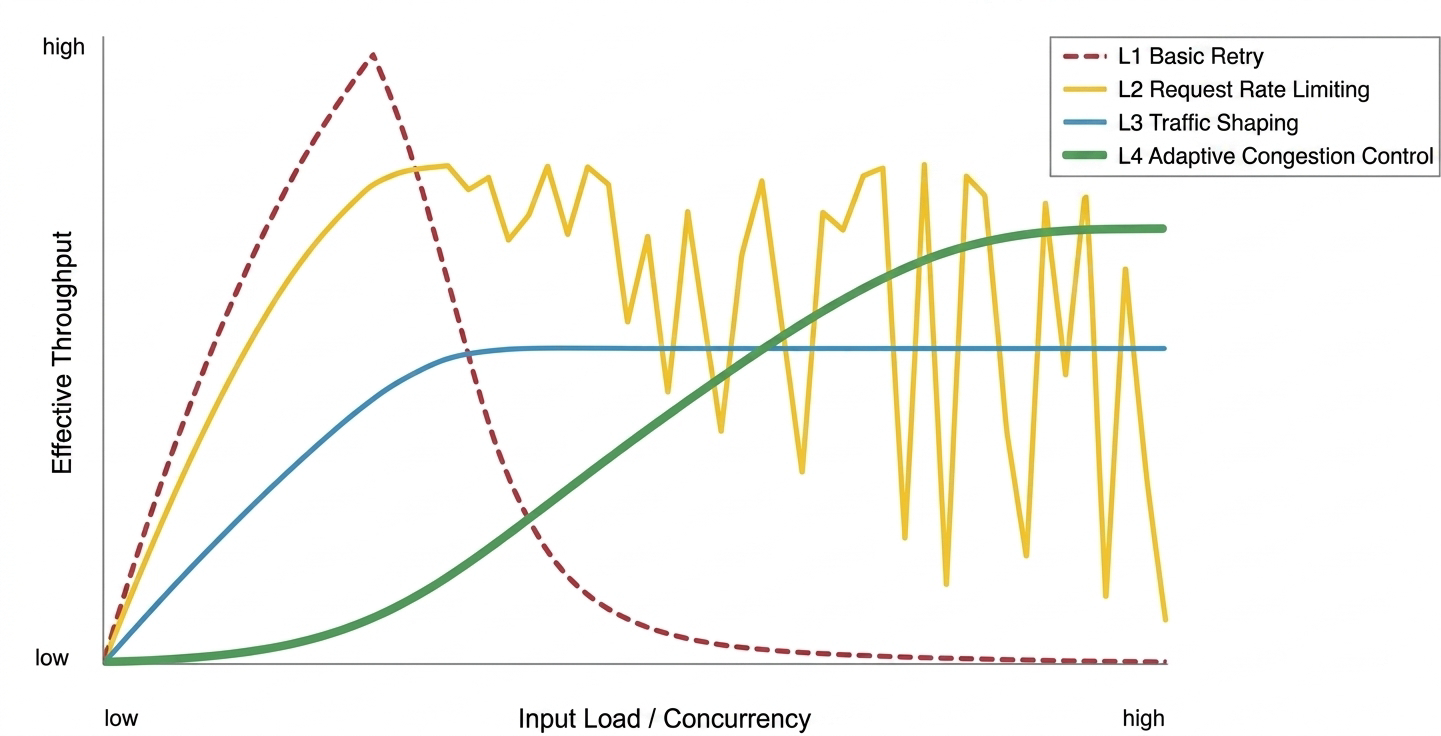
- Basic retry strategy: Effective under low load. Prone to congestive collapse under high concurrency, causing a sharp drop in throughput.
- Request rate limiting strategy: Strong protection against collapse. However, under mixed workloads with long texts, throughput shows sawtooth-like fluctuations due to the lack of token control.
- Traffic shaping strategy: High stability. Achieves smooth output by sacrificing some peak throughput.
- Adaptive congestion control strategy: Can dynamically converge to a stable, high throughput point under high load, but has cold-start probing overhead.
Basic retry strategy
Suitable for personal testing, local scripts, and low-frequency background tasks. No rate limit on outgoing requests. Only triggers exponential backoff retry with random jitter on 429 or 5xx errors.
No proactive traffic control. Under multi-threaded concurrency, this easily triggers rate limiting and causes request backups.
Code example
Code example
- Wait time doubles progressively: For example,
1s, 2s, 4s.... This avoids repeated requests in a short period. - Add random jitter: A random value (such as
2s +/- 0.5s) spreads retry traffic, preventing a secondary flood (thundering herd effect).
Request rate limiting strategy
Passive retries alone cannot handle real traffic. Frequent retries increase latency. This strategy introduces active traffic control: check and throttle requests before sending them, organizing unordered traffic into a queue that respects the RPM limit. Active smoothing adds a small, predictable queuing delay — far less than the cost of a "error — wait — retry" loop. A small known cost beats a large unknown one.
Suitable for chatbots and other lightweight, request-response services sensitive to time to first token.
Client-side active queuing uses two levels of control:
- RPM token bucket: Limits total requests per minute. Bucket capacity equals the RPM quota; tokens refill at a constant rate. Supports borrowing: if tokens are insufficient, a request borrows from future quota, strictly FIFO.
- Concurrency semaphore: Limits concurrent requests to prevent instantaneous high concurrency from triggering RPS limits.
initial_tokens=rpm_limit), suitable for online services that need to process requests immediately at startup. If a full bucket triggers rate limiting, lower the initial value (for example, initial_tokens=0 for an "empty bucket start") to ramp up more gradually.
This strategy does not track token usage. Long-text tasks can still exhaust the TPM quota.
Code example
Code example
Traffic shaping strategy
In batch scenarios requiring high, stable throughput (real-time RAG ingestion, bulk long-document analysis), request rate limiting has a TPM blind spot. Traffic shaping adds dual resource awareness (RPM & TPM) and a shaping mechanism that converts bursty traffic into a smooth flow.
Enhancements over request rate limiting:
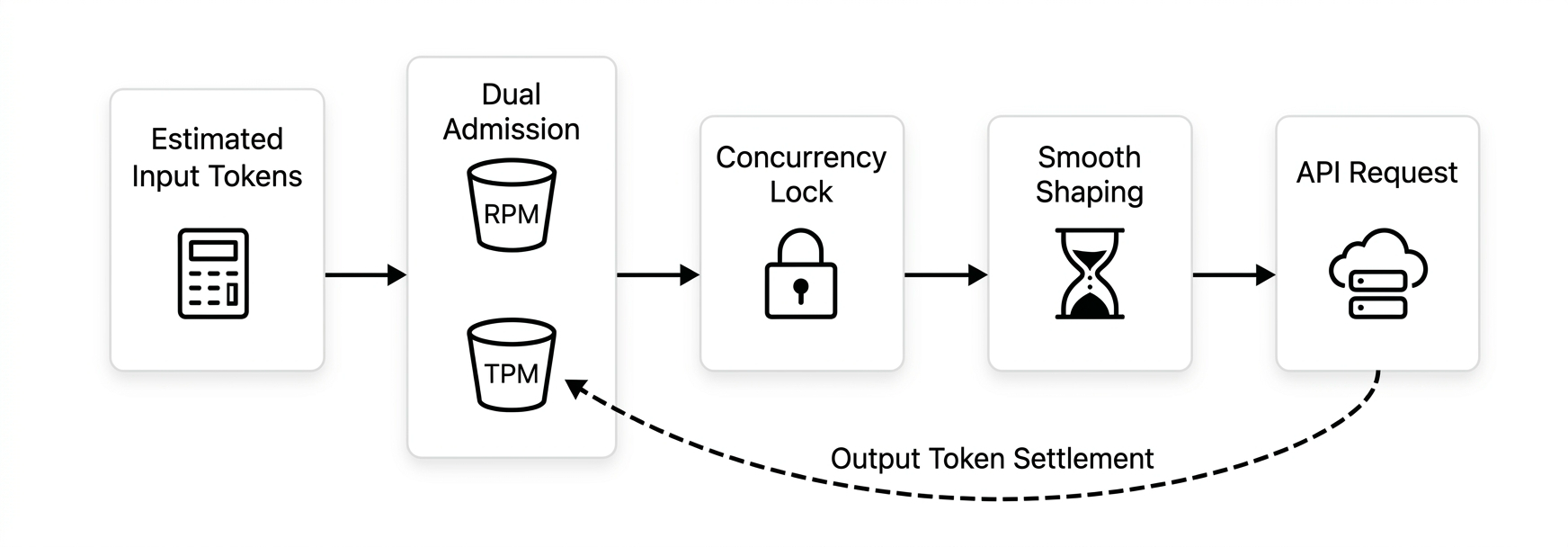
- Dual resource control (RPM & TPM): Maintains both RPM and TPM token buckets. All requests must pass quota checks for both dimensions before being sent.
- Pre-deduction for input, post-settlement for output: Output length is unknown before the request. The TPM bucket pre-deducts input tokens when sending and settles actual output tokens after completion. Even if tokens go negative, subsequent requests wait for the count to become positive, naturally smoothing the flow.
- Continuous warm-up: During a cold start, the token issuance rate increases linearly over time, eliminating the risk of initial bursts.
- Smoothing rate limiter (Pacing): Smooths the sending rate by enforcing a minimum interval between requests (pacing), reducing the risk of triggering rate limits.
initial_tokens=0) for a safe start with lower complexity. The Python token bucket here is for demonstration. In production, use mature rate limiting libraries such as Guava's SmoothRateLimiter in Java.
In the code example, the smoothing wait is placed inside the concurrency lock. Multiple requests might compete for the semaphore simultaneously after their wait ends, re-bunching the traffic at the exit. Smoothing inside the lock slightly reduces concurrency efficiency but ensures precise send intervals.
The complete traffic shaping pipeline is: Estimate input tokens → Dual admission (RPM & TPM) → Concurrency lock → Traffic shaping → Send → Settle output tokens.
Code example
Code example
Adaptive congestion control strategy
Suitable for large-scale, dynamic workloads: API gateways, complex proxies, multi-tenant systems.
- Performance paradox: If the load is predictable (such as batch processing), optimal static parameters outperform dynamic probing that needs "trial and convergence".
- Probing overhead: Dynamic algorithms inevitably involve cold-start ramp-up and exploratory fluctuations — unnecessary overhead in known scenarios.
- Maintenance cost: Closed-loop feedback increases system complexity and troubleshooting difficulty.
- EBP: Stores the historical highest successful watermark. Calculates probing gain by simulating spring tension based on the distance from current concurrency to the watermark (farther = faster, closer = slower). Adds a small linear thrust to keep exploring even at high saturation.
- TPT congestion awareness: LLM generation time scales with output length — high latency on long texts does not mean congestion. TPT (Time Per Token) filters out content-length noise. Congestion is only declared when TPT degrades significantly.
- Anti-burst rate governor: Regardless of the EBP target, the governor caps concurrency growth acceleration to ensure smooth ramp-up and avoid step changes that trigger growth rate limits.
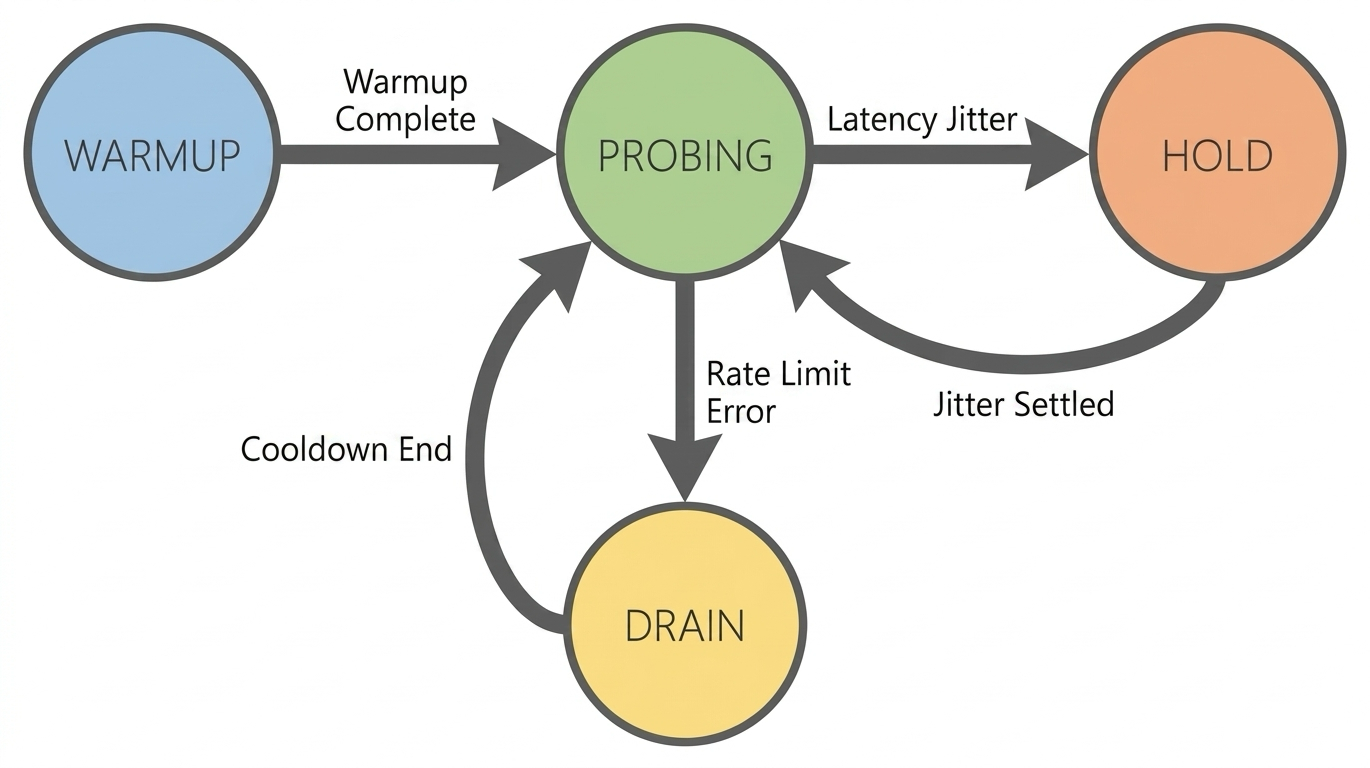
- Guided probing: Introduces known RPM/TPM quotas as a "guiding upper limit" to avoid frequent collisions caused by blind probing.
- Signal source (RTT → TPT): Native BBR uses RTT. In LLM scenarios, content-length latency dwarfs network jitter. TPT eliminates that interference.
- Response mechanism enhancement (ProbeRTT → Hold): In the face of latency fluctuations, it chooses to maintain the current concurrency level rather than proactively backing off and reducing throughput.
- Hard rate limit response (Packet Loss → 429 Drain): Once a
429error is triggered, it enters an aggressive Drain state and performs a fast recovery after a cooldown period.
- TPT noise: TPT is estimated as "total latency / total tokens". Total latency includes network round-trip, queuing, and time to first token — susceptible to jitter or long inputs, which can falsely trigger the Hold state.
- Large request starvation: Uses a non-strict FIFO wakeup for scheduling performance. When quotas are scarce, short-token requests may preempt resources, causing long-token requests to wait too long.
- Cold start: Requires a warm-up period to build a statistical model. In low-load or short-lived tasks, throughput may be lower than the first three strategies.
Code example
Code example
Architectural fallback solutions
When platform configuration and client-side traffic control still cannot meet availability or peak throughput requirements, add fallback mechanisms at the architecture level.
Model fallback
When the primary model cannot respond due to rate limiting or service issues, automatically fall back to an alternative model with a more generous quota.
Fallback path design principles
- Choose models from different series: Rate limiting is per-model. Use a different model as fallback — for example, fall back from
qwen3.6-plustoqwen3.6-flash. - Trigger fallback only on rate limit errors: Fall back on
429errors, not all exceptions. Switching models will not fix network timeouts or parameter errors. - Validate the fallback model in advance: Ensure it supports required features (Function Calling, structured output, etc.) to avoid functional issues after fallback.
Code example
Code example
Peak-load shifting using message queues (MQ)
For backend services that do not require immediate responses, introduce a message middleware (RabbitMQ, Kafka) for peak-load shifting. Burst traffic goes into the MQ first; consumers pull and process at a steady rate matching the rate limit quota. This decouples frontend peaks from backend calls.
Suitable for businesses where users accept asynchronous results: ticket processing, content moderation, batch data annotation.
Key design points:
- Consumer rate control: The consumer side should use the request rate limiting or traffic shaping strategy to consume messages at a steady rate based on the RPM/TPM quota, rather than pulling messages without limits.
- Dead-letter handling: Move messages that fail after multiple retries to a dead-letter queue and trigger an alert. Prevent infinite retries from blocking consumption.
- Back-pressure propagation: When the MQ backlog exceeds a threshold, propagate pressure upstream (for example, return a queuing status) to prevent unbounded queue growth.
Production environment considerations
The code examples use a Python asyncio single-threaded loop to demonstrate core algorithms. Before large-scale production use, consider the following.
-
Adapting to non-text models
The strategies above use text models as examples, but the core principles apply to multimodal services (image generation, speech synthesis). The units differ, but the essence is the same: limiting submission rate and processing capacity.
- Models such as speech recognition are typically constrained by both the number of requests per unit of time (such as RPM) and usage (such as audio duration). The strategies are basically the same as for text models.
- Models for images and videos are typically constrained by the task submission rate and the number of concurrent tasks. You can use the same approach as the request rate limiting strategy: limit the task submission rate and use a semaphore to control concurrency.
-
Atomicity in concurrent models
Example:
asynciouses single-threaded cooperative scheduling, so state modifications are inherently atomic within a single process. Production: In multi-threaded or multi-process environments, ensure concurrency safety of the token bucket and statistics window. Race conditions will break traffic control. - Distributed rate limiting Example: All traffic control components are in-memory. Production: In multi-instance deployments, each instance throttles independently. Total usage may exceed the limit. Use a centralized counter (such as Redis) to manage usage across all nodes.
- Priority queues and starvation prevention Example: No priority differentiation. The adaptive congestion control strategy uses non-strict FIFO wakeup for scheduling performance. Production: For high/low priority requests, implement a weighted priority queue to guarantee bandwidth for high-priority traffic. Reserve a minimum quota for low-priority queues to prevent starvation.